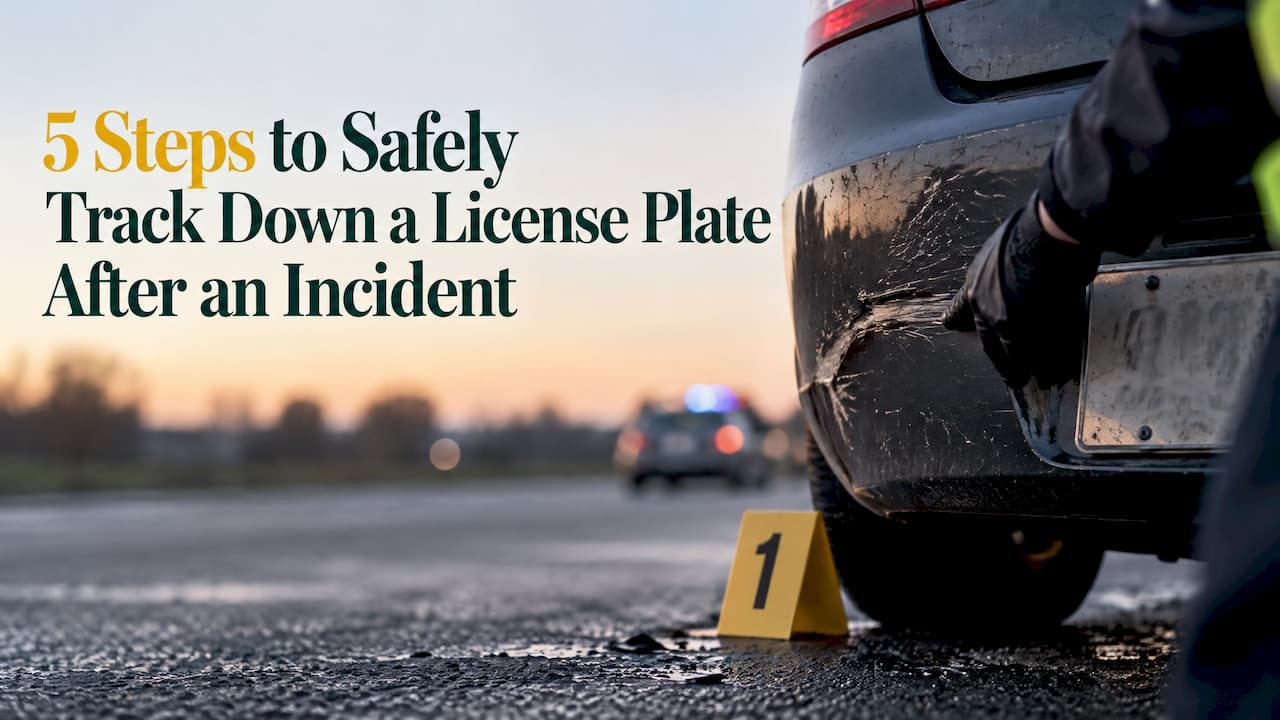
A license plate can usually confirm a vehicle's year, make, and model, and sometimes its VIN, but it will not hand you a private owner's name or address. If you just witnessed something worth reporting, write down the exact plate and state, note the time and location, take photos, and either run a lawful plate lookup or call police or your insurer right away.
TL;DR:
- License plate searches reveal vehicle details such as year, make, model, and sometimes VIN, but never owner names or addresses due to federal privacy laws.
- A precise plate reading requires slowing down for accuracy and photographing the vehicle from multiple angles, capturing timestamped images when possible.
- Confirming vehicle identity involves matching the plate to the VIN through physical inspection and vehicle history reports like NMVTIS, not relying solely on plate data.
- In urgent cases like hit-and-runs or theft, immediately report all evidence, including photos and candidate data, to authorities rather than attempting to identify the owner yourself.
- Wildcard partial-plate searches help generate vehicle candidate lists, but results are limited to vehicle data and should always be verified by VIN before acting.
Table of Contents
- What to do the moment you spot a plate worth tracking
- What a plate search actually gives you back
- Why owner identity stays off-limits
- Turning a plate lead into a verified vehicle history
- Deciding when to call in police, insurers, or investigators
- How a wildcard partial-plate search actually works
- Balancing safety, privacy, and effective reporting
- A lawful way to search partial or custom plates
- Sources
- FAQ
What to do the moment you spot a plate worth tracking
Precision matters more than speed. A single misread character turns a solid lead into a dead end, so slow down enough to get the plate exactly right, including the issuing state and any distinguishing plate style (vanity, specialty, dealer, or temporary paper tag).
Photos and video do the corroborating work later. Capture the plate straight on and at an angle, get the whole vehicle in frame for color and body style, and if your device timestamps images, leave that data intact rather than cropping it out.
- Write down the plate character by character, plus the state.
- Photograph the plate, the vehicle, and the surrounding scene from two or more angles.
- Note the exact time, street, and direction of travel.
- Run a lawful plate lookup for vehicle details, or report directly to police or your insurer.
- Stay clear of the vehicle and its driver rather than approaching or following.
Pro Tip: If a character is smudged, obstructed, or uncertain, mark it as unknown instead of guessing. A wildcard search built for partial plates will handle that gap far better than a wrong letter typed with false confidence.
What a plate search actually gives you back
A plate lookup is a vehicle report, not a people finder. Most services return a narrow band of data pulled from vehicle records, and knowing that band ahead of time keeps you from expecting something the search was never built to deliver.
- Vehicle basics: year, make, model, body type, and sometimes trim.
- Identification data: a full or partial VIN, when the source has one on file.
- History flags: title brands like salvage or rebuilt, depending on the service.
- What you will not get: the registered owner's name, address, or phone number, which federal law protects.
- State overlap risk: identical plate sequences can exist in different states, so the state code is not optional context, it is part of the identifier.
Treat every result as a candidate, not a confirmed match. Visual confirmation against your photos and, wherever possible, VIN verification are what turn a plausible guess into something you can act on.
Why owner identity stays off-limits
The reason plate searches stop short of a name and address is not a product limitation, it is federal law. The Driver's Privacy Protection Act, explained in the Department of Justice's brief in Reno v. Condon, restricts the release of personal information from motor-vehicle records to a defined list of permitted purposes.
- Permitted uses include law enforcement, motor vehicle safety, insurance claims, and licensed private investigations.
- Casual curiosity, personal disputes, or attempts to confront or harass a driver are not covered purposes and can carry legal exposure.
- When you need owner identity rather than vehicle data, the correct move is handing your candidate results and evidence to police or your insurer, who have lawful channels the public does not.
Owner information tied to a license plate is protected under federal privacy law, restricted under the Driver's Privacy Protection Act to specific permitted purposes rather than open public access. That single fact explains almost every limitation you will hit while searching.
Turning a plate lead into a verified vehicle history
A plate gets you a candidate. The VIN is what confirms it, since it is a unique identifier stamped into the vehicle itself, typically visible through the windshield on the driver's side dashboard or on the driver's door jamb sticker.
- Generate candidate vehicles from the plate, state, and any wildcard characters you needed.
- Confirm the VIN against the physical vehicle or a trusted record rather than relying on the plate alone.
- Pull a vehicle history report through NMVTIS to check title brands, salvage or total-loss status, and the latest reported odometer reading.
- Run the VIN through NHTSA's recall search, which accepts either a plate or a VIN but flags that plate-based results can reflect a previous owner if state DMV data has not caught up.
- Arrange an independent inspection before any purchase decision, since NMVTIS and recall data are fraud and safety signals, not a full maintenance record.
Skipping the VIN step is the most common mistake. A plate match that looks perfect can still belong to someone who sold the car months ago.
Deciding when to call in police, insurers, or investigators
Some situations call for official involvement immediately, not after you have exhausted your own research. Hand things off promptly when you are dealing with a hit-and-run involving damage or injury, a stolen vehicle, threats or harassment, or suspected fraud in a private sale.
- Report the exact plate and state, the timestamp, and the precise location.
- Include your photos or video, along with any witness names and contact information.
- Attach whatever candidate search results you already generated.
- If a sale is involved, keep seller messages, listings, or transaction records intact.
Present candidate matches as leads for investigators to verify, never as a confirmed identity you are announcing yourself.
How a wildcard partial-plate search actually works
When you only caught part of a plate, a wildcard search lets you enter the characters you are sure of and mark the rest as unknown, then filters state vehicle data down to a manageable list of candidates. WhosHit built its search around exactly that gap, since a witness rarely gets a clean, complete plate in the moment.
- You submit known characters plus the state, and the system fills in the rest as wildcards.
- Results come back as vehicle-level candidates: make, model, year, and available VIN data, never an owner's name or address.
- Data is drawn from verified third-party vehicle sources rather than scraped public records, and the platform's lawful-use guidance spells out which purposes the tool is meant for.
Pro Tip: Run every strong candidate through a VIN check before you act on it, and if the goal is identifying a hit-and-run driver rather than confirming a used car, route your findings to police instead of pursuing the person yourself.
Balancing safety, privacy, and effective reporting

The instinct after a close call is to want a name immediately, but chasing one yourself risks a confrontation nobody needs. Preserving clean evidence and routing it through official channels does more for an actual outcome than any amount of amateur sleuthing.
A plate search is a starting point for an investigation, not a replacement for one; VIN confirmation is what separates a solid lead from a coincidence.
**
A lawful way to search partial or custom plates
WhosHit sells one thing: a wildcard license plate search that turns partial or uncertain plate characters into a shortlist of matching vehicles, drawn from verified third-party vehicle data. It does not sell owner names, addresses, or phone numbers, and it is not built for casual curiosity about a neighbor's car.
- Useful when you have a partial hit-and-run plate and need candidate vehicles to hand to police or your insurer.
- Useful for verifying a private-sale vehicle's basic details when the seller has not shared a full VIN yet.
- Useful for checking whether a custom or vanity plate combination is already in use.
Subscription and credit details are available on the pricing page, and the platform's approach to handling search data and its privacy choices are both documented for anyone who wants the details before running a query. Keep every search inside the lawful purposes described in the legal guide, and start your candidate search on the license plate search page.

Sources
NHTSA covers recalls by VIN or plate, NMVTIS covers title and salvage history, DOJ guidance on the DPPA sets the legal boundary, and your state DMV handles record requests.
- Check for Recalls: Vehicle, Car Seat, Tire, Equipment | NHTSA
- Reno v. Condon (DOJ brief) — explanation of DPPA limits
- Vehiclehistory
FAQ
How do you track your plate?
Write down the exact characters and state, take clear photos of the plate and vehicle, and run a lawful plate lookup for vehicle details like make, model, and year. For anything involving an incident, forward that information to police or your insurer rather than trying to identify the owner yourself.
Can you look up a license plate for free in Florida?
Free plate lookups typically return only basic vehicle details, not owner information, since the Driver's Privacy Protection Act restricts personal record disclosure nationwide to permitted purposes. For anything beyond vehicle basics, the request has to go through official channels such as police or a state DMV.
Is there a free way to look up license plate information in Ohio?
Free tools generally return vehicle details such as year, make, and model rather than owner identity, and results can reflect prior registrations if state data has not updated. For recall status specifically, NHTSA's search by plate or VIN is a reliable free option.
Can I find the owner of a license plate for free?
No reliable free option provides a registered owner's name or address, since that information is protected under the Driver's Privacy Protection Act and limited to permitted purposes like law enforcement and insurance claims. If you need owner identity for a hit-and-run or theft, the correct path is reporting the plate and your evidence to police rather than searching for it yourself.