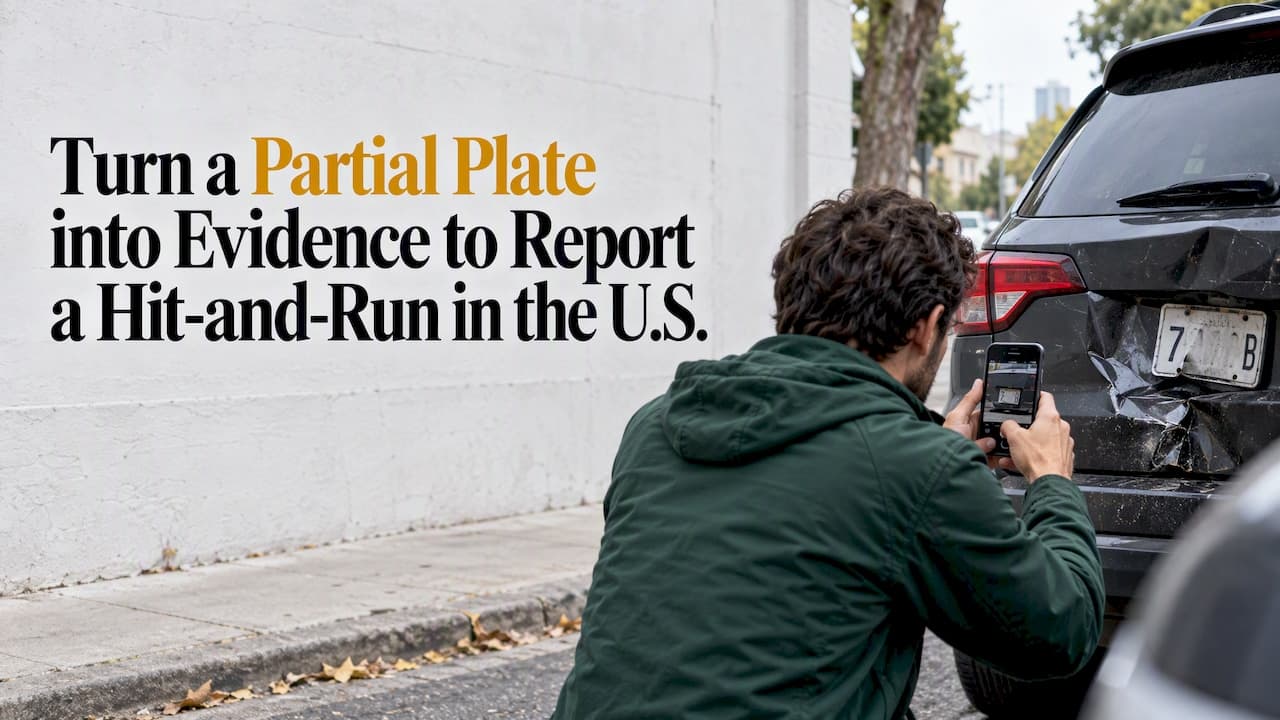
If you caught part of a license plate during a hit and run, the fastest next move is a wildcard license plate search paired with vehicle descriptors like make, model, color, and any visible damage. Run the search, save every result with timestamps, and hand the candidate matches to police. This process narrows a partial plate down to a short list of real vehicles instead of leaving you stuck on three or four random characters.
TL;DR:
- Wildcard license plate searches are most effective when combined with vehicle descriptors like make, model, color, and unique damage features, significantly narrowing results.
- Conduct the search immediately at the scene, documenting all partial plate characters, scene details, and witness reports before inputting data and reviewing candidate matches.
- Automated license plate readers often produce false reads due to obstruction, dirt, or motion blur, so matches should always be cross-verified with images, timestamps, and vehicle features.
- Save search results, screenshots, and scene evidence in an organized packet for law enforcement, omitting any attempt at confrontations or address visits based solely on candidate data.
- Use services such as WhosHit for legitimate investigations to generate leads, while respecting privacy laws and avoiding misuse of vehicle data for harassment or stalking.
Table of Contents
- What a wildcard license plate search actually does
- Step by step: from scene to verified candidates
- How plate-reading systems generate matches, and where they fall short
- Building a verification checklist before you contact police
- Staying on the right side of privacy and lawful use
- Why WhosHit fits this job
- A straightforward workflow worth sticking to
- Run a wildcard plate search with WhosHit
- Sources
- FAQ
What a wildcard license plate search actually does
A wildcard plate search is not the same as filing a police crash report. It is a lookup process where you enter the plate characters you remember, exact or partial, and let wildcard symbols stand in for anything you missed.
A typical query looks like this:
- Exact plate: "7KPL240" when you got a clean read.
- Partial with trailing wildcard: "7KP*" when you only caught the first three characters.
- Partial with a gap: "7KL20" when the middle blurred but the ends stuck.
Precision improves fast when you add the issuing state, make, model, color, model-year range, and anything unusual: a cracked taillight, a missing hubcap, a roof rack, a bumper sticker. Pairing partial plate text with vehicle descriptors measurably improves how well these searches narrow a candidate list.
Step by step: from scene to verified candidates
Start at the scene, not at the keyboard. Write down every plate character you remember immediately, before memory fades, and note whether you are confident or guessing on each one.
- Document the scene: photograph vehicle damage, skid marks, debris, and the surrounding street, and note the time, cross streets, and direction of travel.
- Collect witness information: ask anyone nearby what they saw, including their own partial plate reads, since multiple partial reads can be combined.
- Build your wildcard query: enter known characters in order, use wildcards for the rest, and select the issuing state if you saw it.
- Add descriptors: layer in make, model, color, and distinguishing features to shrink the result set.
- Run the search and review candidates: look at what each result returns, typically a plate string, vehicle description, and in some cases an image, timestamp, or capture location.
- Cross-check before acting: compare any images against what you saw, check timestamps against the time of the crash, and flag any unique damage or aftermarket parts that match.
A strong candidate match usually lines up on at least three points: plate characters, vehicle type, and a visible feature like color or damage. One match alone, especially just a partial plate, is a lead worth checking, not a confirmed identification.
Pro Tip: Save your wildcard pattern exactly as you typed it. Investigators may need to reproduce your query or request vendor logs for the same search.
Do not contact or confront anyone based on a candidate match. The goal of this step is building a documented lead for law enforcement, not resolving the incident yourself.
How plate-reading systems generate matches, and where they fall short
Automated license plate readers, mounted on fixed poles or patrol vehicles, photograph passing plates and run the image through optical character recognition. Each read typically comes bundled with a vehicle image, GPS coordinates, and a timestamp, and the system checks the result against hot lists or historical scan databases to generate investigative leads.
That process is not flawless.
- OCR misreads happen often, especially with dirty, bent, or partially obstructed plates.
- Motion blur and poor lighting can turn one character into another that looks similar.
- Matching systems often rely on edit-distance and probabilistic techniques rather than exact text matches, because raw OCR output rarely lines up perfectly with the true plate.
ALPR and commercial plate databases produce leads, not proof. A match tells you a vehicle is worth a closer look, and it still needs a visual or timestamp cross-check before anyone treats it as confirmed.
Building a verification checklist before you contact police
Police move faster when you hand them an organized packet instead of a vague description. Before you call, pull your evidence into one place.
- Screenshot every search result, including the timestamp the search ran and the exact wildcard pattern used.
- Export any image captures tied to a candidate match, if the search returned one.
- Preserve your original scene photos and witness notes, since these corroborate or rule out a candidate.
- Record the wildcard pattern you ran, written exactly as entered, in case investigators need to repeat the query.
- List any nearby cameras, such as parking garages or storefronts, along with their approximate locations and the time window to request footage.
Keep in mind that police may still need a subpoena to pull footage from private security cameras or to request detailed logs from a commercial plate-reader vendor. Your packet speeds up their work, but it does not replace the legal process for obtaining footage you cannot access yourself.
Staying on the right side of privacy and lawful use
A plate search returns vehicle information, not a confirmed identity, and that distinction matters for how you use the results. Treat every candidate as a lead for police, never as grounds to approach or contact a stranger yourself.
- Never use plate-search results to stalk, harass, or dox anyone.
- Never show up at an address tied to a candidate vehicle.
- Always route findings through law enforcement rather than acting on them directly.
- Review a service's lawful-use policy and privacy practices before running a search, since these set the boundaries for what the data can and cannot be used for.
Why WhosHit fits this job
This wildcard-first workflow lets you enter exact or partial plate characters, let wildcards cover the gaps, and get back vehicle candidate data drawn from verified third-party sources rather than public records. It returns vehicle details, not owner names, which keeps results inside the lead-generation role police investigations actually need.

The platform documents its security practices, publishes a service status page, and lays out lawful-use terms so you know what a search can and cannot be used for. It can be used for narrowing hit-and-run candidates and for checking a vehicle's plate details before a private purchase. Either way, final confirmation and any confrontation stays with investigators, not with you.
A straightforward workflow worth sticking to
Wildcards plus descriptors beat a bare partial plate every time, and verification beats assumption every time after that. Build your evidence packet, run the search, confirm what you can, then let police take it from there.
— John
Run a wildcard plate search with WhosHit

A caught plate fragment does not have to stay a dead end. WhosHit lets you enter the characters you have, exact or partial, fill the rest with wildcards, and get back real vehicle candidates pulled from verified third-party data instead of a guess.
- Start your search on the License Plate Search page with whatever plate characters and vehicle details you have.
- Check pricing and credit options before you buy, since searches run on pay-per-use credits or a subscription.
Remember that WhosHit hands you vehicle candidate data, not owner names. Once you have a solid match, package it with your scene evidence and bring it to the officer handling your case.
Sources
- Innovative Uses of Automated License Plate Readers To Enhance Criminal Investigations | Office of Justice Programs
- Law Enforcement and Technology: Use of Automated License Plate Readers (Congress CRS)
- UCSD research on visual recognition and retrieval
FAQ
What inputs work best for a partial plate search?
Give the exact characters you remember, mark the rest with wildcards, and add the vehicle's make, model, color, and state if you saw them. Combining partial plate text with these descriptors narrows results far more than the plate alone.
Can a plate search give me the owner's name?
No. Services like WhosHit return vehicle candidate data, such as make, model, and matching plate strings, not owner identity, and that is by design to keep the tool within lawful-use limits.
How accurate are these search results?
Results are investigative leads, not confirmed matches, since OCR-based reads and database matching can misfire on obstructed or blurry plates. Always cross-check images, timestamps, and distinguishing vehicle features before treating a match as solid.
What should I give police after finding a candidate match?
Hand over your screenshots with timestamps, the exact wildcard pattern you used, your scene photos, and any nearby camera locations worth checking. Police may still need a subpoena for private camera footage or vendor logs, so an organized packet speeds up that process.
Is it legal to run a plate search myself?
Running a plate search for a legitimate purpose, like identifying a hit-and-run vehicle or checking a vehicle before purchase, is generally fine, but using results to harass, stalk, or confront someone is not. Review a provider's lawful-use guide and privacy policy before you search, and route any findings through law enforcement rather than acting on them yourself.